Information Wars
Harassment and intimidation of Japanese journalists are on the rise and violence is a real possibility, say media unions.
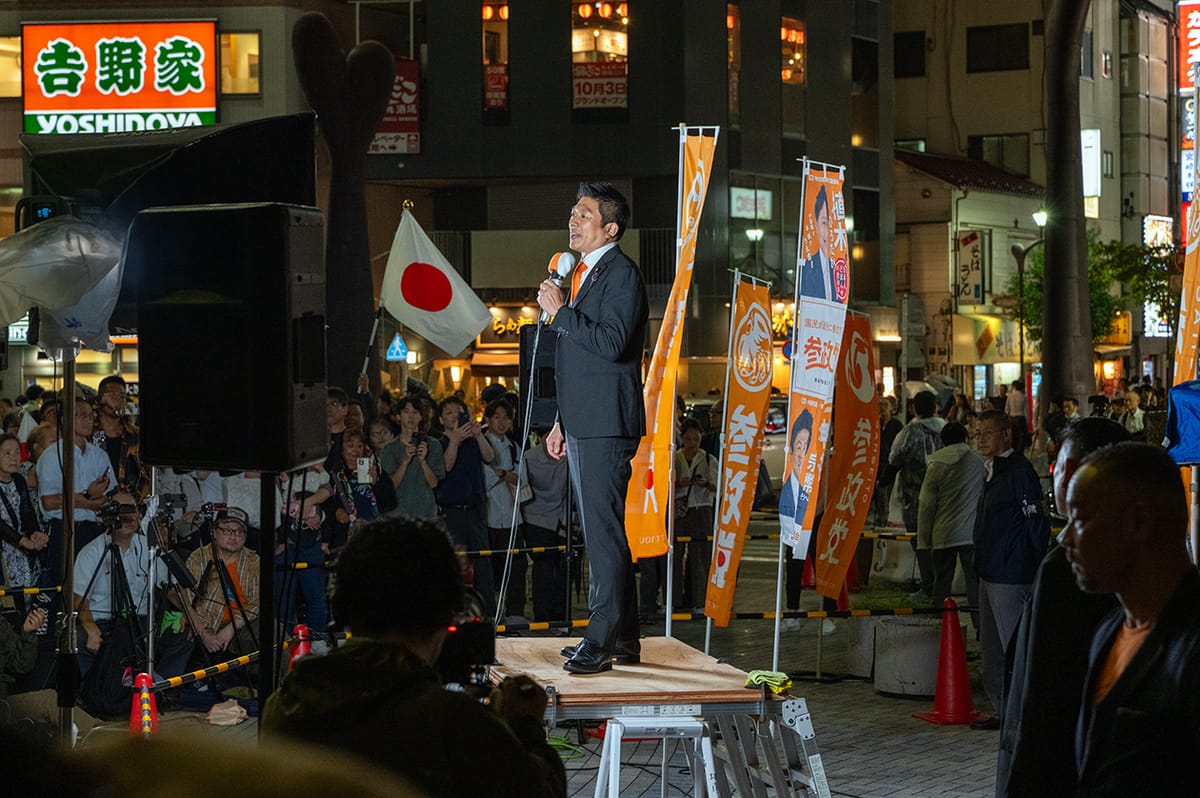
Takashi Tachibana personifies the warring line between old and new media. A former program producer with NHK, Tachibana resigned after leaking stories about expense-padding and other accounting scams at his publicly funded employer. He has since morphed into an implacable foe of Japan’s flagship broadcaster, and swapped allegiance from NHK’s careful presentation of pseudo-establishment views for the unfiltered, wild west of social media.
On Nov. 9, Tachibana, head of anti-NHK party, was arrested after leading what many saw as an online lynch mob against Hyogo politician Hideaki Takeuchi. Tachibana accused Takeuchi of masterminding claims of bullying that forced Hyogo Governor Motohiko Saito out of office last year. Saito was reelected in November, boosted by an online campaign against “fake” legacy media. Relentlessly harassed by internet trolls, Takeuchi committed suicide two months later, aged 50.
Tachibana faces charges of spreading false online claims.
Tachibana arrested
MAGA-style trolling, targeting politicians and journalists with false or distorted information and even physical threats is growing in Japan. In October, Yoshihiro Murai, the incumbent governor of Miyagi Prefecture accused his election opponent, the Sanseito-backed Masamune Wada (another former NHK employee) of spreading scare stories about the selloff of water rights to “foreign” companies.
Murai insisted that just one of 10 private companies that bought operating rights for the prefecture’s water utility was non-Japanese, but says his message was drowned out by online misinformation.
Miyagi election
Inevitably, media workers have been caught up in the resulting information wars. In August, Sanseito Party banned a reporter from the Kanagawa Shimbun from attending a regular press conference. The journalist and the newspaper, which have been critical of the rightwing party’s anti-immigration policies, have since been hounded by Sanseito supporters.
Japan's Sanseito removes reporter critical of party from press conference mainichi.jp/english/arti...
— FujiiPonta (@fujiiponta.bsky.social) 2025-07-26T06:44:25.039Z
Tomomi Akasaka of Kyodo News is among several journalists who have complained about being harassed after covering hate speech against Kurds in Saitama Prefecture. Japan’s small Kurdish community, clustered in the cities of Kawaguchi and Warabi have been targeted by groups seeking their expulsion. Reporters who cover the story can often expect a tsunami of abuse.
Some are sounding the alarm. “As journalists it is only right to accept valid criticism from people who disagree with us,” says Yoichi Tanaka, a journalist with the Kobe Shimbun. “But these sort of concentrated harassment campaigns are entirely new.” Tanaka says some stories about Saito generated 500 calls a month, with newsroom staff bearing the brunt, and warns that personal attacks on journalists have reached “unprecedented levels.”
“Violence is a possibility if this does not stop,” Tanaka says, noting the increasingly abusive language used online and during campaign trails.
A typical line of attack by Tachibana, for example, was to accuse the mainstream media of hiding behind privacy laws when reporting on the Saito election. “We had to respect these laws but Tachibana said we were biased in our reporting against Saito,” says Tanaka.
One in five reporters harassed
In another recent case, Fumitake Fujita, leader of Nippon Ishin no Kai, posted the business card of a journalist from Shimbun Akahata on his X account, in what many interpreted as an attempt to intimidate the reporter. Though there is little evidence that harassment is organizationally driven, trolls are sometimes jolted into action by dog-whistling politicians.
Tachibana-led protestors, for example, have gathered in front of the homes of politicians and outside newspapers like the Kobe Shimbun. “What’s most worrying is that there is no reasoning with such people,” says Tanaka. “That inability to find any middle ground is frightening.”
A survey by Kobe Shimbun union taken after Saito’s election found that a fifth of its membership had suffered verbal attacks. Many had their names, photos, and requests for interviews posted on social media. Journalists at other newspapers have taken sick leave, and expressed fear of going out to report, particularly outside Tokyo. In response, newspapers have removed office addresses and even telephone numbers from business cards.
In October, the Japan Federation of Newspaper Workers’ Unions issued a protest letter on behalf of its regional members, pledging to “continue to seek out and communicate facts” and “resist attacks on journalists via social media and other channels. Makoto Nishimura, chairperson of the federation argued that attacks on reporters are not only a labor issue but about the “public’s right to know.”
立法事実の存在しない国旗損壊罪なんかじゃなく、維新の藤田文武共同代表やN党の立花孝志代表(どちらも自民党の連立政党と共同会派だな)が駆使する、SNS上で不特定多数の者に特定の個人や団体への攻撃をけしかける犬笛行為に刑事罰を一刻も早く設けてほしい。
— 小野マトペ (@matope.bsky.social) 2025-11-07T15:13:54.305Z
Hyogo Prefecture has a particular reason to be concerned about violence against journalists. In May 1987, a masked rightist murdered reporter Tomohiro Kojiri at the The Asahi Shimbun’s Hanshin bureau in Nishinomiya. His colleague, Hyoe Inukai, was badly hurt. The perpetrator has never been caught. “There’s a real possibility of escalation if we cannot put a break on what’s happening, especially when the line between the online world and the real world is so blurred,” says Tanaka.
Tanaka wants local politicians to do more to damp down such campaigns in the interests of democracy. He says his newspaper has received a threat from a caller using the name, “Sekihotai,” the organization that claimed responsibility for killing Kojiri. “People who view us as enemies online are meeting us in the real world. It’s frightening.”


Comments ()