
Part 2: NHK - Does Japan’s powerful public service broadcaster serve the public?
The core purpose of the media in any democratic society should be to as watchdog for the public interest, monitoring abuse of power. But this takes hard work and courage.
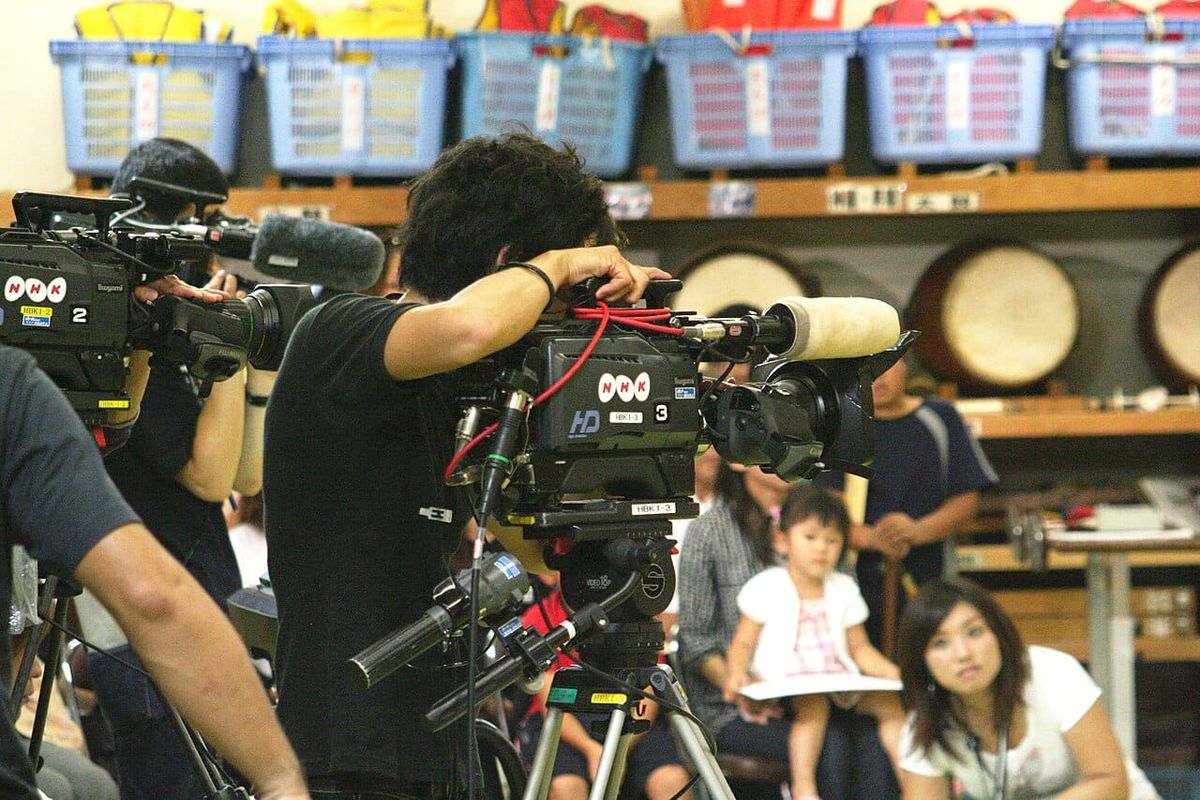
This is the second in a multi-part series exploring Japan’s national broadcaster, NHK, and its increasing inability to avoid political interference and inform the Japanese public about sensitive topics.
Read part one here.
In 2014 the Times newspaper in the United Kingdom obtained a copy of the book from an NHK whistleblower and ran extracts. As The Times story noted, the book instructs editors, translators and journalists to avoid using the expression ‘so-called comfort women’ or give explanations of what they were: “Do not use ‘be forced to,’ ‘brothels,’ ‘sex slaves,’ ‘prostitution,’ ‘prostitutes’ etc.” The book says the 1937 destruction of the Chinese capital by the Imperial Japanese Army must be referred to only as “the Nanjing Incident”. “‘The Nanjing Massacre’ is used only when directly quoting remarks made by important people overseas etc., when the fact that it is quotation must be made clear.”
In reference to Yasukuni, the Shinto shrine that venerates Japan’s wartime leaders along with its 2.4 million war dead, NHK employees must avoid English expressions such as “war-related shrine,” “war-linked shrine” and “war shrine”. References to the Senkaku Islands were not to include the phrases “dispute” or “disputed islands”. That reflects the Japanese government’s view that the islands are clearly Japanese and, therefore, there is no dispute over their sovereignty. “The word ‘issue’ can be used only when expressing Japan’s position that ‘the territorial issue does not exist’,” the book says. These rules appear to reflect the position of the govennment of Shinzo Abe, noted The Times.
At the time, I was employed by a subsidiary of NHK as a part-time rewriter for its news programs and I was unsettled by this book, particularly as a journalist and someone who taught about the dangers of censorship. It was history being rewritten. What’s more, it completely hobbled NHK’s ability to report stories. How could NHK discuss China’s repeated naval incursions into waters around the Senkakus without noting that a dispute not only exists, but also poses a serious threat of war? Is it possible to describe the comfort women issue without noting any of the background or the controversy over definitions? Why was it OK to describe, for example, the terrorist attack on the 1972 Munich Olympics (in which 17 people died) as the “Munich Massacre” but not Nanjing (in which many died)?
In 2017, I wrote a chapter in a book about media freedom in Japan, in which I lamented briefly that NHK appeared to be buckling under government pressure. I cited as an example the compilation of the “Orange Book,” a stylebook for NHK’s international broadcasting arm, NHK World. Many global media organizations such as AP, The Guardian and the BBC publish stylebooks, openly available. Unlike those companies, however, NHK’s book was marked ‘secret’, meaning it was forbidden to remove it from the NHK building in Shibuya.
We launched the book at Temple University Tokyo in March 2017 to a crowd of about 100 people. In the audience was someone from NHK who reported me to management. The following month I was called to a hearing with my managers where I was reminded that my contact bans me from writing about NHK. I was stopped from ever working again at NHK World. Before the hearing ended, I was asked if I could remove a video of the Temple University book launch and talk from YouTube. If I understood this exchange correctly, my NHK managers were asking me to censor a public discussion about censorship at NHK, which was grimly funny.
NHK insiders talk of the potential for pushback from senior staff, who are keen to be seen as not openly contradicting government policy. The result is a subtle manipulation of the language of news that, at best, confuses viewers and, at worse, misinforms them. So, it follows that disputes about history are mostly Korea and China’s fault; a nuclear meltdown becomes “core damage”; a technical recession is spun into a “slowdown”, and women who were corralled across 10 countries to serve in Japanese wartime brothels are “those referred to as comfort women”.
Editors hired by NHK from CBC, Canada’s public service broadcaster, to give its programs a professional sheen, often expressed deep frustration at the practices they found. “CBC should shut down the NHK program based on the state of journalism in Japan”, wrote one in 2016. “We sign off on propaganda. We help legitimize NHK towing the government line….Nothing journalistic to be gained. Instead it challenges everything you thought you knew and spins your moral compass…”
In fact, it isn’t even fulfilling the brief set out on its own website: Unlike a state-sponsored broadcaster such as Russia Today, Iran’s Press TV or China’s CCTV, which are run under strong state supervision, a public broadcaster should be run independently of state control, the website says. Otherwise, we might as well call it “state-sponsored media”.
In his 2000 book, Broadcasting Politics in Japan: NHK and Television News, Ellis S. Krauss suggests that of all the democratic world’s public broadcasters, NHK should be the most independent. It collects its own fees. Money doesn’t come directly from the government (though the Broadcast Law stipulates a small sum of money from the government go to NHK World. NHK often argues that NHK World should conform to the government line because of this). In theory, NHK should be protected from interference from the government of the day.
“Theoretically, at least, even if accountable to public authority, NHK should have the most autonomy from the state of any broadcaster in the industrialized democracies,” Krauss writes.
NHK has a duty not to alienate its viewers, Krauss continues, but in a paragraph about public broadcasters that should be embossed on every license payer’s NHK contract, he adds: “As an influential component of the ‘fourth estate’ of journalism, however, they are also supposed to reveal embarrassing and critical information about the government in order to keep it accountable to the citizens.”
Krauss was writing about the Japan three decades ago, but NHK’s duty to the public – including exposing uncomfortable truths about the government’s performance, is as important today as it was then.
NHK is full of talented, smart people. It was heartbreaking, infuriating to see so much of this talent and money wasted. The core purpose of the media in any democratic society should be to as watchdog for the public interest, monitoring abuse of power. But this takes hard work and courage. It is far easier to avoid conflict by mouthing the official line on history, foreign policy, territorial disputes and other issues.


Comments ()