
Part 3: NHK - Does Japan’s powerful public service broadcaster serve the public?
The failure of the media to be a public watchdog can have profound consequences. On a day-to-day level, debate about complex issues: historical fidelity, relations with Japan’s three biggest neighbors, the possibility of conflict with China – is cheapened and blurred.
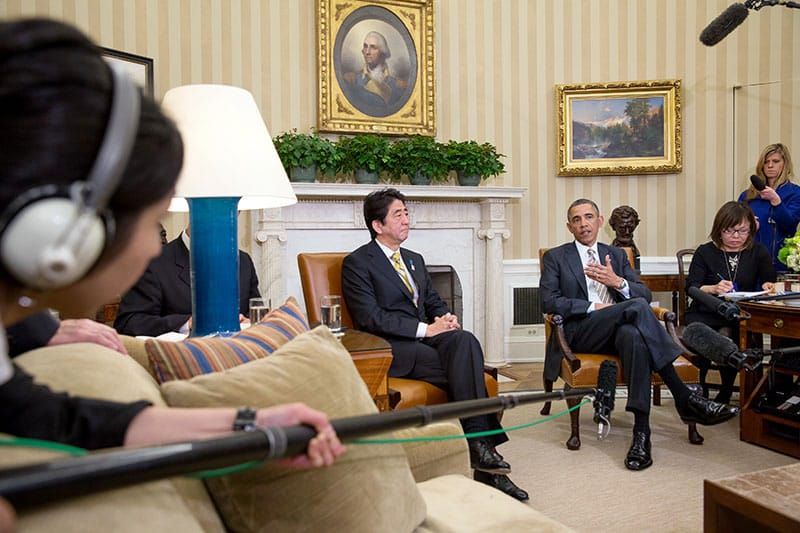
This is the third in a multi-part series exploring Japan’s national broadcaster, NHK, and its increasing inability to avoid political interference and inform the Japanese public about sensitive topics.
Read part one here and part two here.
Japanese politicians have long had a tense relationship with NHK. In 2001, Shinzo Abe, then the deputy chief cabinet secretary, had learned in advance that a documentary would devote airtime to a mock trial, held in 2000, that found wartime Emperor Hirohito guilty of permitting war crimes. After Abe’s intervention, in which he described the content as “clearly biased,” the program went to air, but minus the “guilty” verdict against Hirohito, and with less time than originally allotted to testimonies from former victims and repentant ex-soldiers.
When Abe returned to power in 2012, one of his government’s first moves was to install on the company’s 12-member board four conservative allies led by Director-General Katsuto Momii. There was barely a murmur in the Japanese media when the Diet approved them in late 2013. Momii aside, the new members of the management committee (経営委員会)included Naoki Hyakuta – a popular novelist who reportedly “bonded” with Abe during an interview with the rightwing magazine Will – and Katsuhiko Honda, a former president of Japan Tobacco who was Abe’s home tutor when he was at elementary school.
Hyakuta, whose bestselling book Eien no Zero (The Eternal Zero) was made into a hit film, has called for the “destruction” of the Okinawan newspapers the Ryukyu Shimpo and the Okinawa Times, and denied that Nanking ever happened. He supported Toshio Tamogami’s campaign for governor of Tokyo in 2014. Tamogami, who was sacked as chief of staff of the air self-defense forces in 2008 after writing an essay justifying Japan’s war in the 1930s and 40s, was arrested in 2016 for allegedly making illegal payments to staff on his governorship campaign.
Another Abe appointee to the NHK board, Saitama University professor Michiko Hasegawa, was the author of Our Truly Terrifying Constitution, in which she warned that “the three pillars of the 1947 Constitution - people's sovereignty, human rights and pacifism – inevitably lead to revolution, the death of monarchs, the guillotine, terror and Japan's dismemberment.”
Hasegawa’s elevation to the NHK board came a month after she wrote an essay praising Shusuke Nomura, an extreme nationalist who committed ritual suicide in the offices of the Asahi Shimbun in 1993 in protest at its mockery of his rightwing group. "It is only to God human beings can offer their own lives," she wrote in the essay. "If it is devoted in the truly right way, there could be no better offering. When Nomura committed suicide at the Asahi Shimbun headquarters 20 years ago, he … offered his death to God."
The Abe appointees repeatedly denied editorial interference and it is doubtful whether anyone could prove it anyway. But one of the outcomes of their stewardship was to increase the incentives for NHK employees toward greater self-censorship.
This could hardly have been a surprise since it was signaled by Momii on his appointment. Momii had barely got his feet beneath the table at the company’s headquarters in Shibuya before he broke the golden rule of public broadcasting and practically declared himself and all those who work under him servants of the government.
In his first public address as head of NHK, Momii, a former vice chairman of a trading house with no previous broadcasting experience, said it was “only natural” for the broadcaster to side with the government’s position on contentious issues in its international output.
Asked about Japan’s dispute with China over ownership of the Senkaku islands in the East China Sea (known as the Diaoyu in China), Momii said: “International broadcasting is different from domestic. It would not do for us to say ‘left’ when the government is saying ‘right’.” It was “only natural to state Japan’s position in no uncertain terms,” he added.
Even before Momii arrived, I was struck throughout my time at NHK by its shocking journalistic ellipses. A story in 2010 about a large demonstration on Okinawa did not have any figure for the number of demonstrators (perhaps the single most important bit of information). When I asked about this the editor said “nobody could agree” on such numbers (the standard practice in the British media is to cite figures by the police and organizers). A week later, our story about a demonstration inside North Korea (against accusations that the North has been involved in the sinking of the South Korean ship the Cheonan in March 2010) contained a very precise figure for the number of protestors.
During the Fukushima crisis of 2011, a senior editor asked me if we could find another word for ‘radiation’, because he didn’t want to “sensationalize” the nuclear accident. “We’re not CNN,” he said. What word would you suggest, I asked. “How about ‘dirt’, he replied.
Stories about territorial disputes or the imperial family induced the most nervousness among senior editors. In 2016, a foreign journalist at NHK World wrote: “NHK has learned some news from the Imperial Household that could soon mean the end of an era in Japan. Emperor Akihito intends to step down in the coming years.” The senior editor erased that lead, saying NHK couldn't say it would be the end of Heisei “because it's up to the Imperial Household to decide”. The writer explained "end of an era" simply refers to Akihito's time but she was overruled.
Rewriters and translators were instructed not say the Northern Territories are 'off' Hokkaido (despite the fact that few outside Japan know what 'Northern Territories' because they are administratively part of Hokkaido and “therefore cannot be off the coast of said island.”
In 2013, Shinzo Abe became the first sitting prime minister in 84 years to visit Ise Shrine, where he attended (with eight cabinet members) the most important ceremony in Shinto, the Sengyo no Gi at Ise shrine – a centuries old ritual in which the main shrine buildings are demolished and rebuilt. Ise is considered home to the emperor’s ancestors – Amaterasu is enshrined in the inner sanctum. The ceremony was the top story on NHK News Nine.
The highlight of the ceremony is the removal of a mythological “sacred mirror” used to lure the sun goddess out of her cave, a symbol of the legitimacy of the emperor. Some scholars were agnostic on the visit, given that prime ministers routinely go to the shrine to show respect for traditions and culture. But others were alarmed because Ise Jingu was the “fountainhead for unifying politics and religion and national polity fundamentalism," said Hisashi Yamanaka. None of this vital context was noted in the NHK report.
In general, NHK seemed very slow to report scandalous stories about Japan that had already broken abroad, such as the 2009 Toyota recall or the 2011 Olympus scandal. The suspension of Japan’s annual whaling hunt in the Southern Oceans in 2011 after harassment by environmental activists was ignored for several days (a story where NHK could actually make Japan’s case to a foreign audience).
On issues pertaining to North Korea, disputed territory or WW2, NHK news became even less likely to argue with the government line. Teams of editors hovered over the screens of rewriters before such stories went on air to make sure there were no mishaps over wording.
There is dissent in the ranks at NHK. Line managers would sometimes speak aloud about how Abe was “wrecking” journalism. According to minutes of an NHK board of governors held in February 2016, the outgoing executive director, Hiroyuki Tsukada, complained that senior executives had been engaged in “damage control” ever since Momii became president.
Then there was the mischievous parting shot from Masaya Shimokawa when he stepped down as senior director in April 2015. Comparing today’s “independent” NHK with its prewar and wartime counterpart, he said: "(NHK) lacked the courage to say 'left' when the wartime government was saying 'right' since it was effectively a state-managed broadcaster.”
Yet, the failure of the media to be a public watchdog can have profound consequences. On a day-to-day level, debate about complex issues: historical fidelity, relations with Japan’s three biggest neighbors, the possibility of conflict with China – is cheapened and blurred. Look at how NHK compromised in its coverage of the Olympics: In January 2021 a planned debate program on the Olympics, scheduled for January 24th, was abruptly cancelled. Clearly, studio bosses were worried that the outcome of the debate would be: "Let's not have Olympic this summer.” The Olympic torch relay broadcast on NHK was censored to block out protestors against the Games. How is this in the public interest?
In 2021, NHK World reported that the government planned to announce the release of “contaminated water” from the Fukushima Daiichi plant into the ocean. After complaints from TEPCO, the headline was changed to “Govt. approves release of treated water (処理水, shorisui) into sea.” If the water wasn’t contaminated then TEPCO would have let it flow into the sea from Day 1.
In the long run, the public can be railroaded into disaster, as we saw, for example in the US with the decision to invade Iraq in 2003 on the basis of false information, willingly amplified by the media. As for Japan, nobody needs a history lesson about what happens when the media fails.
“Avoidance of controversy, pandering to audiences, parochial nationalism; these appear to be the three basic tenets of NHK’s current operations,” concludes media scholar Kaori Hayashi. “They are diametrically opposed to the original spirit of public service broadcasting as it developed after World War II.”

Comments ()